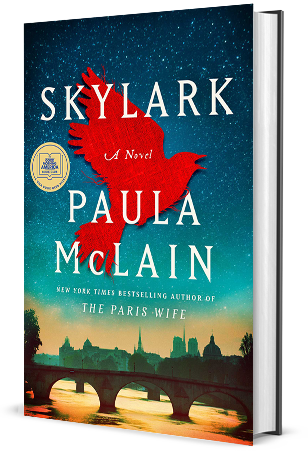
Reading Group Guide
This reading group guide for Skylarkincludes an introduction, discussion questions, and ideas for enhancing your book club. The suggested questions are intended to help your reading group find new and interesting angles and topics for your discussion. We hope that these ideas will enrich your conversation and increase your enjoyment of the book.
Introduction
A mesmerizing tale of Paris above and below—where a woman’s quest for artistic freedom in 1664 intertwines with a doctor’s dangerous mission during the German occupation in the 1940s, revealing a story of courage and resistance that transcends time.
Topics & Questions for Discussion
1. Skylark was inspired by the real-life network of tunnels under Paris. Were you at all familiar with these and their history prior to reading the novel? What did you discover that surprised you about the history of Paris while reading Skylark?
2. At the start of the novel, Alouette and her father’s lives revolve entirely around the world of fabric dye. She says that colors from “legendary crimsons, impossible indigos” to “Tyrian purple” occupy every free space in their lives, and bleed into the occupied ones. What does their obsession reveal about their characters and about the society in which they live? What did you make of the fact that the right to wear certain colors was reserved for people of high social rank? Today, what do we infer about people from the type of colors or clothes they choose to wear?
3. Why do you think Paula McLain decided to interweave dual narratives to create this story? What do Kristof and Sasha’s narratives in World War II have in common with the stories of Alouette and the women confined in Salpêtrière in 1664, and vice versa?
4. When Alouette is walking in the orchard at Salpêtrière, she encounters the superioress tending a small, twisted sapling. She tells Alouette, “Everything worth keeping must be tended. Sometimes at all costs.” What do you think the superioress is trying to convey to Alouette? Did her actions in the orchard change the way you thought of her?
5. When Alesander shows Kristof the tunnels for the first time, he tells Kristof that his grandfather used to say that every city has an aboveground face and a belowground face that only few remember. Have you ever experienced a city this way? If so, what did the belowground reveal that the above did not?
6. When we first meet Alouette, she feels disdain for the meaning of her name: Skylark. As she endures increasing hardship at Salpêtrière, do you think her perception of her name changes? Can you pinpoint any particular moments when she embraces her namesake?
7. Alouette’s connection to Etienne sparks just as she prepares to flee from her life in Saint-Marcel. Sasha and Gerard find one another just as antisemitism overtakes Paris. Love seems to find the main characters during particularly tumultuous or perhaps inopportune times. What are some of the challenges of these relationships, and what are some of the benefits?
8. The impact of an individual person’s bravery is an important theme throughout the novel. Though none of the characters in Skylark are responsible for the circumstances of the world in which they find themselves, they still muster the courage to save themselves, and more importantly, to try to save those around them. Did you understand why characters like Alouette and Alesander were driven to action? What does that say about resistance and why some engage in it while others do not?
9. Paris could be considered its own character in the book, from the descriptions of the Bièvre to the Seine, the rue des Gobelins, and, of course, the tunnels and catacombs. What stood out the most to you about Paris in these time periods? Did anything about the differences and similarities between the 1600s and the 1900s surprise you?
10. The treatment of psychological illness, though it would not have been known as such in Alouette’s time, is one of the many threads connecting the two time periods of the book. Discuss the parallels between the horrors at Salpêtrière and the tragic fates of Kristof’s patients at the hands of the Nazis. In what ways has our understanding of mental illness changed since the 1940s?
11. At the end of the novel, we learn about the book of colors that Alouette has collected, a catalog of the knowledge she and the women in her community in Brittany possess. How did this resolution of Alouette’s identity make you feel? What did it reveal about the multifaceted nature of dyeing and about women’s work more generally?
12. While Alouette’s story ends definitively, Sasha and Kristof’s stories do not. How do you imagine their stories might continue after the end of the book?
Enhance Your Book Club
1. HOME-COOKED POTLUCK—Sasha’s mother, Rachel, takes pride in cooking for her family. Rather than opting for customary French cuisine for your book club, consider accenting it with some special family recipes that are unique to you.
2. ART EXERCISE—In chapter 80, Sacha, Kristof, and their group play a game where everyone creates a poem or drawing by contributing one new element without seeing the previous ones. Try this game with your book club to create a poem or an artwork and discuss the results.
3. MAP IT OUT—Find maps of Paris and France and chart Alouette’s escape from Salpêtrière to the Marais, and then eventually to Camaret-sur-Mer, Brittany. Then chart Sasha’s escape from the rue des Gobelins, into the catacombs at the Parc Montsouris, and finally to Toulouse.